How I Designed a Disaster Recovery Architecture That Achieves Sub-60-Minute RPO & RTO in Production
Disaster recovery is a business problem before it's a technical one. The right strategy starts with a single question: what can the business actually afford to lose? With a tolerance of up to one hour of data loss and downtime, a Pilot Light architecture on AWS proved to be the ideal fit — keeping non-compute infrastructure live in a secondary region at all times, while provisioning compute only at failover. Layered data replication, parallel CI/CD pipelines, and fully automated CloudFormation scripts bring the total recovery time to well under 60 minutes — validated through quarterly DR drills. The key insight: over-engineered DR is a hidden cost, and under-tested DR is a hidden risk.
Sadeel Anjum
April 12, 2026
Downtime is not just a technical problem. It is a business problem.
Every minute a production system is down, revenue is lost, trust erodes, and someone in a boardroom is asking why it happened and how fast it can be fixed. As a Cloud Architect, one of my most impactful responsibilities is making sure that question never has to be asked in the first place. Recently, I designed and implemented a full Disaster Recovery (DR) architecture for a production environment on AWS — achieving both RPO (Recovery Point Objective) and RTO (Recovery Time Objective) comfortably under 60 minutes. Here is how I approached it, and what I learned. \
The Business Context First\
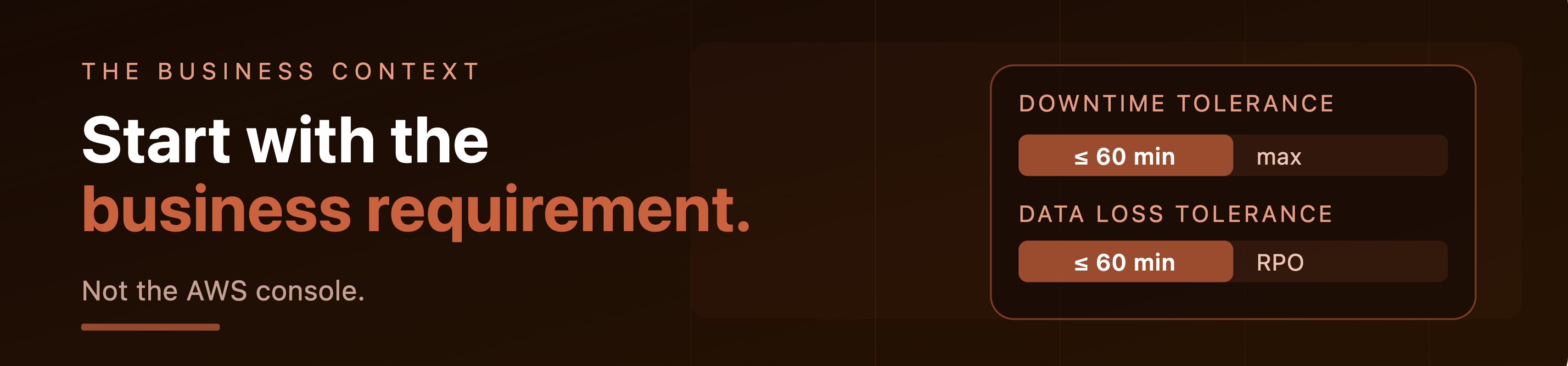
Before touching a single AWS service, I asked the right question: What can the business actually afford?
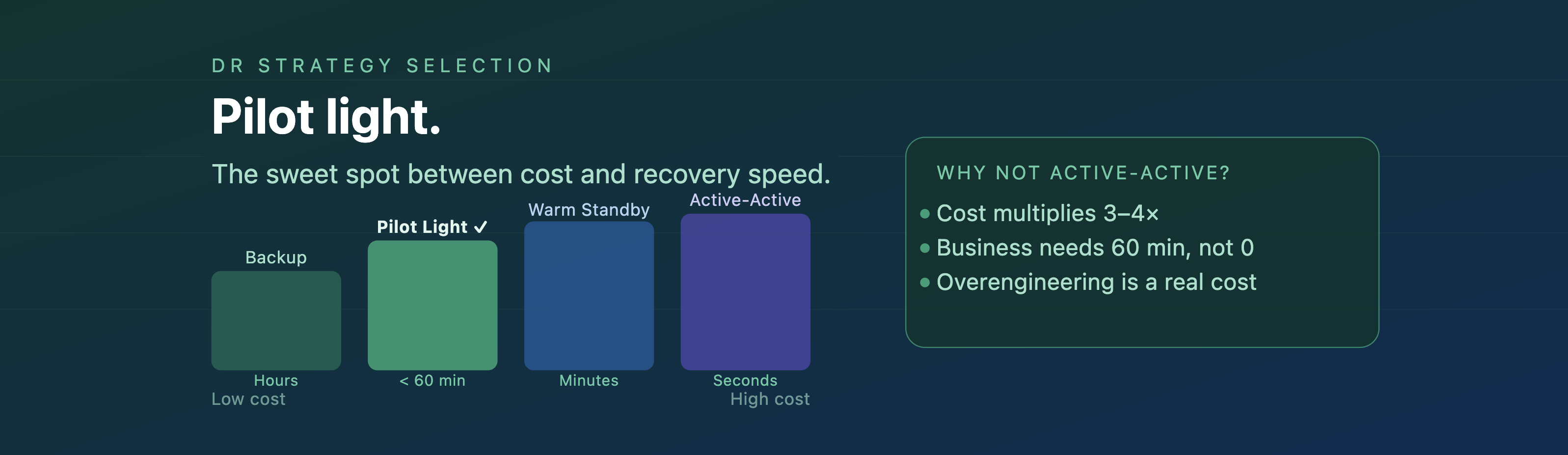
The answer was clear — up to one hour of data loss and one hour of downtime was acceptable. This immediately ruled out expensive, over-engineered solutions like Active-Active or Warm Standby. The business needed protection, not perfection. That distinction matters enormously when it comes to cost.
The right strategy here was Pilot Light — keep the absolute minimum running in the DR region at all times, and spin everything else up only when needed.\
Written by Sadeel Anjum
Cloud Architect · AWS Expert